


Message from the Management
Sustainability Promotion System
Our operations connected to sustainability are promoted primarily by the Sustainability Committee established by MIM.
The Chairperson of the Committee is the President & CEO, all general managers and some planning department staff comprise the committeepersons. Various initiatives are implemented based on the Sustainability Promotion Program which is established every fiscal year.
In principle, the Committee meets twice a year and formulates policies and the content of the Sustainability Promotion Program, monitors progress of programs, deliberates on various suggestions from departments, etc. in light of social conditions and the operating status of MHR.
The President & CEO approves the policies and promotion programs, constantly monitors the thorough promotion of sustainability, and establishes and maintains a sustainability promotion structure as a responsible party in promoting sustainability.
Moreover, sustainability-related efforts are reported on periodically to the Board of Directors of both MHR and MIM.
Each Board oversees the status of initiatives for important issues related to ESG and the status of compliance and risk management.
Initiatives throughout the Entire Supply Chain
Promotion of sustainability operations, whether environmental or social, requires initiatives that involve the whole supply chain. We believe that joint initiatives with various stakeholders with aligned values are necessary.
By actively encouraging interactive communication with stakeholders such as tenants, local residents, property management companies and with our sponsor Mori Building, and by aligning our values, we aim to contribute to the realization of a sustainable society.
Important ESG Issues (Materiality)
Materiality Identification Process
MHR identified areas of Materiality in 2020 through the following process.
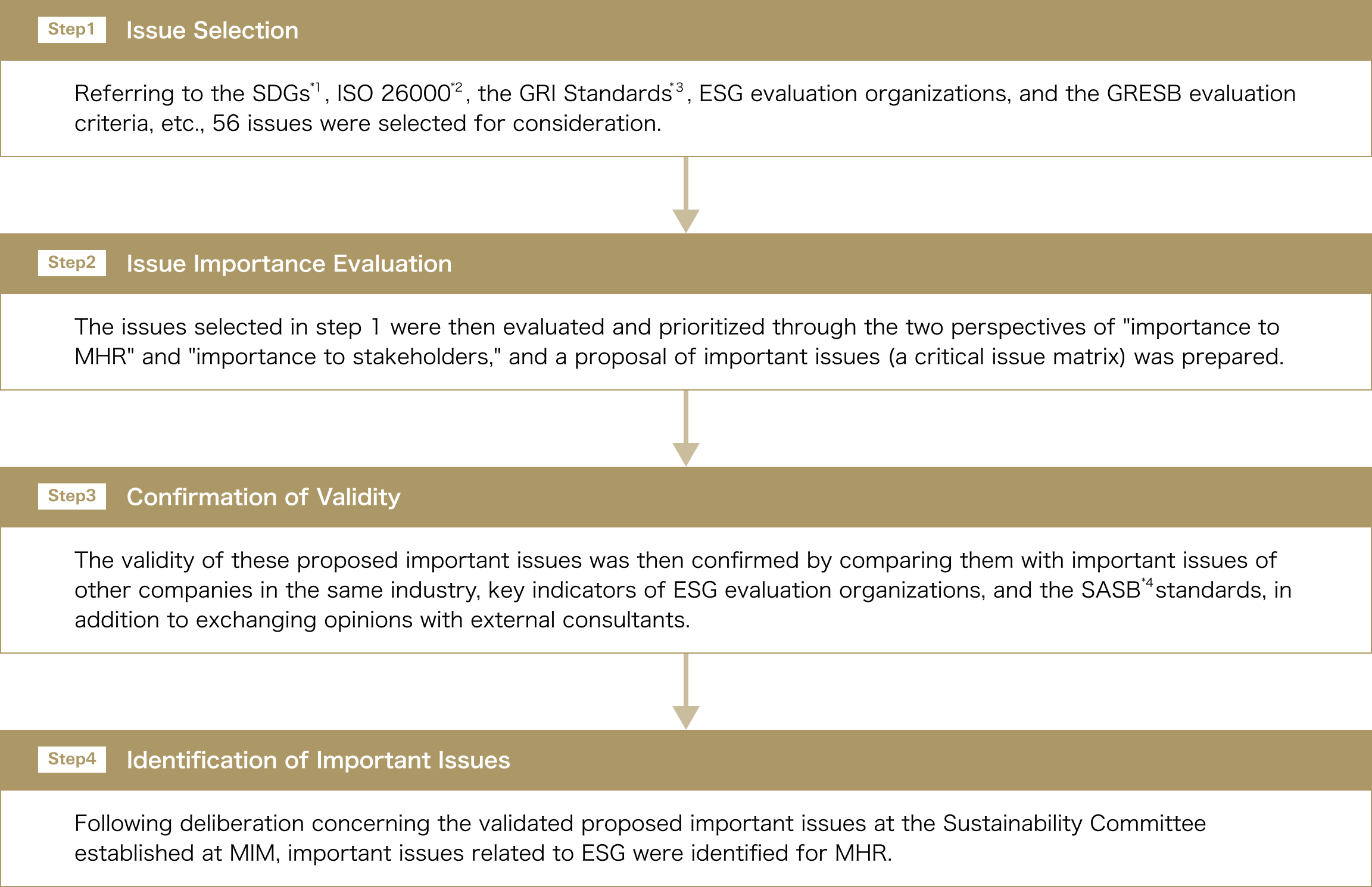
- The SDGs (Sustainable Development Goals) are 17 goals included in the Agenda 2030 for Sustainable Development which was adopted by the United Nations Sustainable Development Summit held in September 2015.
- ISO 26000 is an international standard for organizational social responsibility published in 2010 by the International Organization for Standardization (ISO).
- The GRI Standards is an international standard related to sustainability reporting established in 2016 by Global Reporting Initiative (GRI), an international non-profit organization.
- SASB (Sustainability Accounting Standards Board) is a U.S. non-governmental organization that proposes standards for sustainability information disclosure for companies. SASB develops sector-specific and industry-specific sustainability accounting standards (SASB standards) for companies for when they disclose sustainability information to investors.
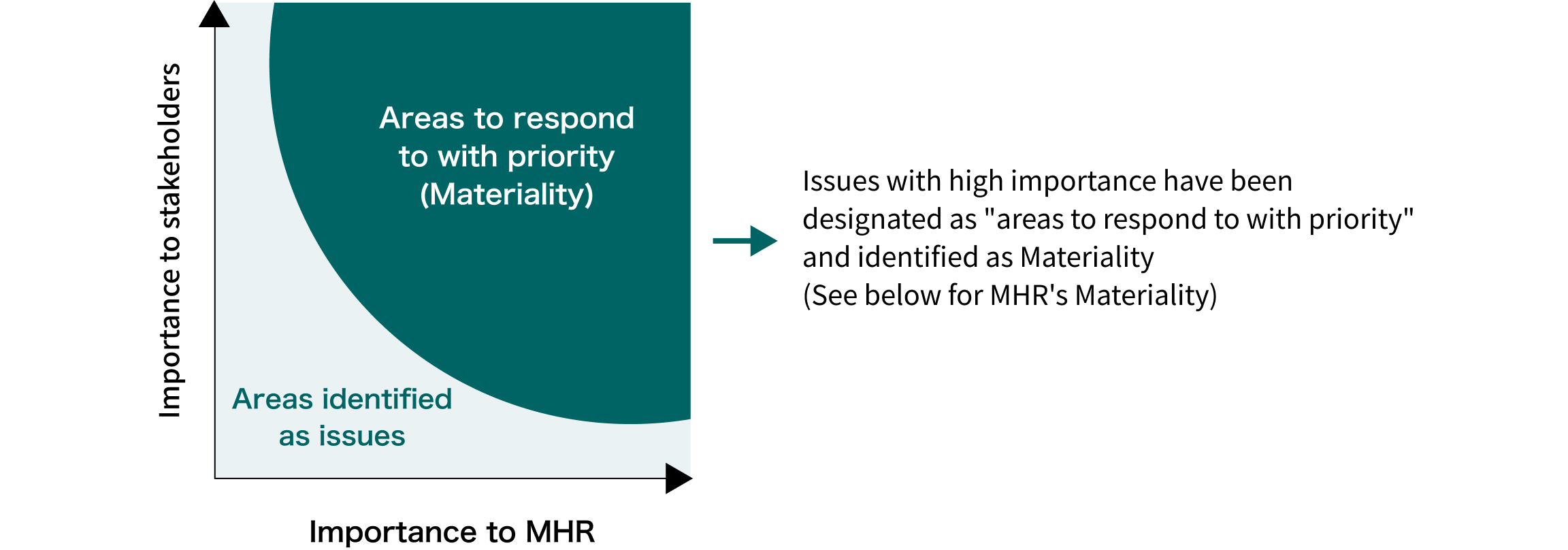
Depiction of Evaluating the Importance of Issues (Critical Issue Matrix)
MHR’s Materiality
This table can be scrolled sideways.
| Materiality | Main Initiatives | Main related SDGs | |
|---|---|---|---|
Environment |
●Reduce greenhouse gas emissions and promote energy saving at owned properties ●Use of renewable energy |
●Participate in Japan Climate Initiative ●Support the TCFD recommendations ●Promote energy savings(such as introducing the energy saving technologies) ●Expand use of renewable energy |
|
Environment |
●Coexist with nature | Promote greenery and take measures against heat island Protection of biodiversity |
|
Environment |
●Response to sustainability certifications | ●Various initiatives to obtain Green Building certifications and make improvements ●Implement training regarding Green Building |
|
Social |
●BCP measures(disaster prevention and building resilience) ●Tenants' health, comfort and convenience |
●Enhance BCP measures ●Strengthen emergency management systems and implement general disaster-readiness training ●Initiative for barrier-free access ●Due diligence when acquiring real estate ●Conduct Tenant Satisfaction Survey |
|
Social |
●Respect fo human rights ●Promote diversity |
●Create an appropriate environment for a whistleblower system ●Implement human rights and diversity training(including LGBT) ●Create a apleasant working environment for women |
|
Social |
●Talent development | ●Provide personnel evaluations and feedback from diverse perspectives including compliance and ESG initiatives ●Provide various courese-based training and qualification acquisition systems |
|
Social |
●Promote a healthy and comfortable work enviroment and improrve employee's work/life balance ●Increase employee's satisfaction |
Promote paid holiday acquisition and overtime work reduction Maintain systems for employee safety an health management Implement health checks Conduct Employee Satisfaction Survey |
|
Social |
●Mutual communications with Stakeholders | (See below for ”Stakeholder Engagement”) |
|
Governance |
●Strive for fair and effective corporate governance ●Adhere to compliance and corporate ethics ●Prevent conflict-of-interest transactions ●Identify risks and manage responses ●Respond to requests for ESG information disclosure |
●Conduct compliance training including fraud prevention ●Regularly expose risks, as well as monitor and respond to risks appropriately ●Enhance ESG information disclosure on the website ●Issuance of Integrated Report |
|
Stakeholder Engagement
MHR conducts its business activities by engaging with various stakeholders including its employees, tenant and local communities, property management (PM) companies, and unitholders. MHR aims for sustainable growth by proactively communicating with its stakeholders to understand and respond to their expectations and requests.
This table can be scrolled sideways.
| Stakeholders | Relationship sith MHR | Main Initiatives Based on Expectations and Requests |
Engagement Methods |
|---|---|---|---|
Employee (MIM)  |
Create a working environment in which a diverse workforce, which is the source of corporate copetitiveness, flourishes | ●Enhance Talent Development Program ●Promote a comfortable work environment and improve employee's work/life balance ●Create a workplace culture that respects human righs and diversity |
●Personal evaluation and feedback(twice a year) ●Conduct of various training ●Employee's satisfaction surveys(once a year) ●Gievance Reporting system(as needed) |
Tenants and Local Communities  |
Secure a competitive advantage by creating an attractive environment for tenants and local communities by providing safe, convenient, an comortable spaces | ●Enhance BCP easyres ubcluding building resilience and disaster reponses ●Provide properties that consider the health, comfort and convenience of tenants ●Interact and conmmunicate with local communities |
●Review owned properties and portfolio PML(as needed) ●Large-scale disaster training at Roppongi Hills(twice a year) ●Tenants' satisfaction surveys(every other year) ●Hold events such as Hills Marche/Hills Machi-Iku project ●Roppongi Clean-Up(once a month) |
PM Company  |
Maintain a competitive advantage at MHR's properties through shared values on sustainability and collaboration | ●Collaborate on climate change measures including upgrading facilities and implementing green leases ●Adhrer to compliance and corporate ethics |
●Confirmation of sustainability systems and policies in writing(once a year) ●Feedback interviews(once a year) |
Investors  |
Carry out stable fund-raising based on trust and increased unitholder value in the medium to long term | ●Conduct investor relations ●Enhance ESG information disclosure ●Obtain sustainability certifications |
●Conduct financial results briefings for institutional investors (twice a year) ●Participate in institutional and private investor conferences (once a year each) ●Conduct individual investor relations meetings with institutional investors (73 times in fiscal 2024) |
