


(Water and Waste) Increasing Greenery and Biodiversity Environment Management System (EMS) Urban Site Investment Criteria Green Finance
Urban Site Investment Criteria
MHR and MIM aim to realize the update and reasonable use of urban functions through urban redevelopment and contribute to public welfare.
MHR and MIM are proactively conducting investment in high-quality urban assets, taking into consideration the environment and safety, which thereby leads to urban regeneration and regional revitalization.
The representative properties owned by MHR are introduced as follows.
Roppongi Hills: Facility Plan and Concept
Facility Plan
Roppongi Hills is a multipurpose city combining “living, working, playing, resting, studying and creating” in an area of approximately 11.6 hectares, based on the concept of a “Tokyo cultural center.”
It contains offices, residences, retail facilities, cultural facilities, a hotel, a cinema complex, a broadcasting center and more.
Fusing art and intelligence, Roppongi Hills is known as the “Artelligent City.”
It attracts people from around the world, and the exchanges between different cultures generate new culture and information.
* Roppongi Hills is the biggest private-sector urban redevelopment project in Japan. After the Roppongi 6-chome district was designated a “redevelopment inducement area” by the Tokyo Metropolitan Government in 1986, it took the involvement of approximately 400 landowners and 17 years to complete.
Concept
Roppongi Hills is located on the south side of Roppongi 6-Chome Crossing where Roppongi-dori Street and Ring Road No. 3 merge, and the planned development site is an area with approximately 11 hectares (excluding Roppongi Hills Gate Tower) surrounded by Roppongi-dori Street, Ring Road No. 3 and TV Asahi-dori Street.
The site of TV Asahi extends from the center of the planned development site, and the height difference between the site and the residential district where low-rise residences centering on wooden houses on the south side concentrate and stand in line was once more than 15 meters.
The residential district was formerly an area with a narrow one-way road where vehicles and people could barely pass each other and also had issues related to disaster prevention as fire trucks could not enter the area.
In addition, although Roppongi 6-Chome Crossing is a place where inter-regional trunk roads merge, only the tunnel on the south side had been developed and it was not connected on flat ground.
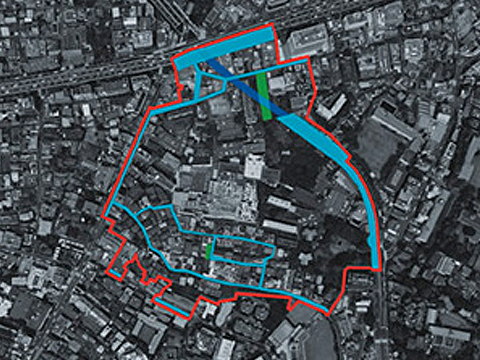
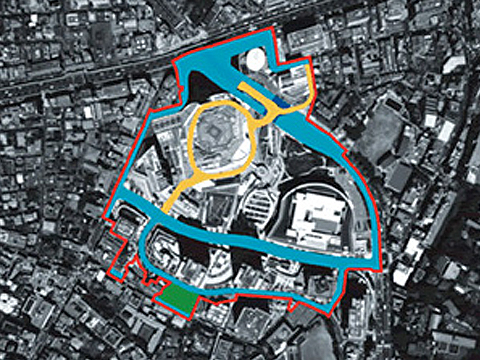
In this redevelopment project, we intended to improve the wide-area transportation network by developing a side road connecting Ring Road No. 3 (Azabu-Juban side) and Roppongi-dori Street on flat ground, which was not realized previously.
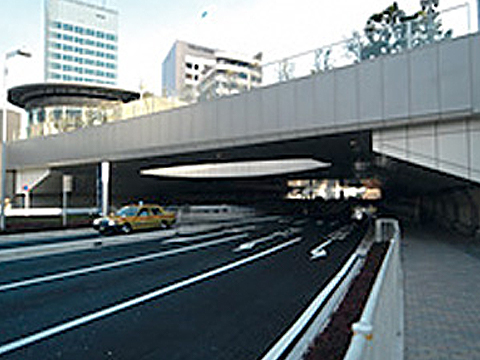
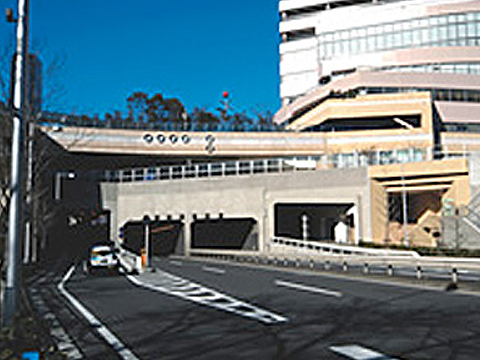
In addition, we established a pedestrian deck similar to a plaza (66 Plaza) at the upper part of the side road, extended the existing underground crosswalk and developed the current intersection.
66 Plaza is connected to a passageway extending to Roppongi Station on the Hibiya Line via an escalator at the adjacent Metro Hat and improves the convenience of the users of the station as well as separates pedestrians and vehicles at Roppongi 6-Chome Crossing and has also secured the continuity of the townscape from Roppongi to Nishi-Azabu.
66 Plaza has a three-layer structure in which the level below it is used as an entrance and exit of the side road and the vehicle road within the site and the level further below it as Azabu Tunnel.
The method behind this structure is unique, adopted in urban redevelopment projects and said to be realized for the first time by planning road construction and construction work on both sides of the road in an integrated manner and executing construction at the same time.
Keyakizaka-dori Street, the main street in the area, runs across the area in an east-west direction and connects TV Asahi-dori Street and Ring Road No. 3.
It was developed as a street space where Zelkova trees line the street and it has a substantial width of 24 meters including the portion with a setback of wall surface at the site on both sides of the street.
We created a pedestrian space offering comfort and designed it based on the image of the streetscape by integrally developing roads and structures along the road.
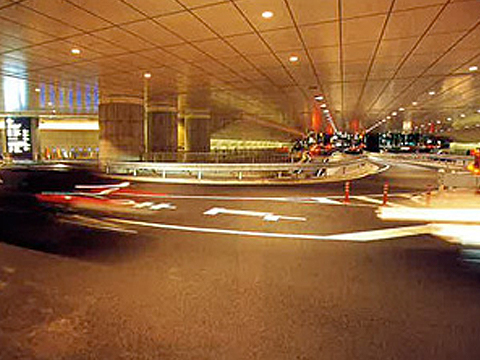
In addition, we developed an exclusive lane for automobiles within the site (Mori Tower 1F/Center Loop), established entrances and exits for parking lots, a carriage porch, a taxi bay and a bus stop on the exclusive lane for automobiles and reduced the impact on surrounding roads as well as sought to secure safety by separating pedestrians and vehicles.
Roppongi Hills: Special Initiatives
Greenery
We are creating a garden-like environment for the entire city by allocating the space at ground level that we created by making high-rise buildings to city streets, promenades, green areas, and parks, and also by adding green areas to the rooftops of buildings.
Disaster Prevention Facilities
Before the development, the road within the area was narrow and steep, in addition to being a bottleneck for emergency vehicles.
We sought to improve convenience by establishing new roads such as Roppongi Keyakizaka-dori Street with a width of 16 meters and length of approximately 390 meters and Roppongi Sakurazaka as well as connecting Ring Road No. 3 and Roppongi-dori Street on flat ground.
Electricity for maintaining urban functions is an essential element and is indispensable to maintain the functions of the city and conduct restoration activities in the event of disasters.
At Roppongi Hills, we are enhancing the reliability of supply by establishing an energy plant that supplies electricity and a heat source within the area.
Power generation facilities constantly generate power by using urban gas, but this system also enables power generation using stocked kerosene in addition to back up of electricity companies.
We installed water supply equipment for firefighting with an area of 100 m³ at a total of 8 locations near the area along the newly established ward road to provide support in the event of disasters within the area or in surrounding areas.
In addition, we developed the Mohri pond that existed even before the development and also secured a route that enables fire pump cars to approach the pond.
We are drilling an emergency well at a location near Mohri Garden and a location facing Roppongi Sakurazaka that can maintain minimum life functions if water supply is suspended in the event of a disaster.
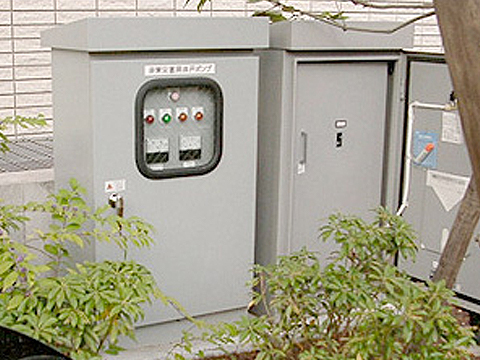
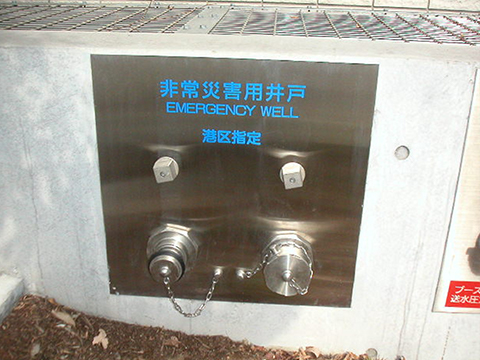
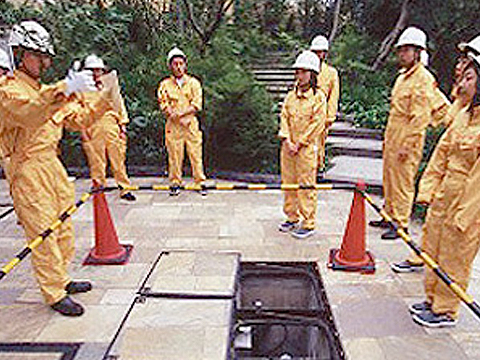
We are developing manholes, etc. to enable the establishment of two portable toilets at Sakurazaka Park (park provided by Minato Ward) for use by people who evacuate to the area in the event of a disaster.
The drainage pipe from the manhole has an earthquake-resistant structure including the connecting part of the sewer pipes and the main sewer pipe.
We are developing a warehouse space with an area of approximately 380 m² on the first basement floor of Roppongi Hills Mori Tower and a stockpile warehouse with an area of approximately 200 m² on the south side of Roppongi Sakurazaka.
For large buildings alone, 11 buildings centering on 3 super high-rise buildings stand in line at Roppongi Hills, and the basement floors and lower floors of the buildings are connected in each block, forming a single town.
Furthermore, they are connected to Roppongi Station on the Tokyo Metro Hibiya Line and to the adjacent Roppongi Hills North Tower via an underground passage, and have connections with facilities in the surrounding area.
We established a disaster prevention monitoring system for the area to make it possible to share information and ensure safety in the event of a town-wide disaster.
Community
In recent times there have been concerns that interaction and connections between people in the heart of Tokyo have been getting weaker, and the approaches of area management and town management have been gaining more attention. Like other concerned entities, Roppongi Hills has been emphasizing activities for “the whole city.”
We inaugurated the Roppongi Hills Self-governing Association to promote horizontal cooperation among the various people who come to the complex, cooperate with the town councils in the vicinity, and further promote urban development as the core of community activities. The self-governing association has inherited the infrastructure of the Roppongi 6-chome Area Redevelopment Association, which had led the urban redevelopment project for 17 years, and was launched to newly welcome the residents living in this complex and the shops and businesses, etc. located here.
Objectives of the self-governing association are to strengthen security for the entire complex, including disaster prevention and crime prevention measures, and to form an open-minded community that is only possible in a multipurpose city like Roppongi Hills, where people of different nationalities, occupations, and ages can actively participate in community activities.
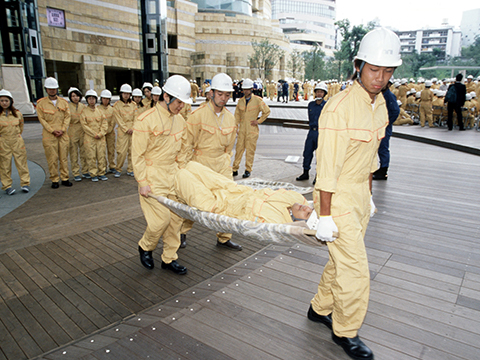
1. Roppongi Hills Earthquake drills
Comprehensive disaster prevention drills are held for the purpose of reducing the scale of damage as much as possible in the event of a disaster.
The emergency wells, emergency supplies and building structure within Roppongi Hills can be checked, and hands-on training such as first-aid treatment will be conducted.
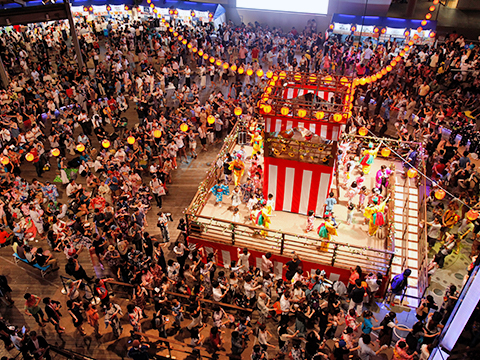
2. Roppongi Hills Spring Festival / Summer Festival
Festivals are held in spring and summer by Roppongi Hills Self-governing Association.
The Spring Festival is held when cherry blossoms start blooming.
The cherry blossoms at Mohri Garden and the row of young trees along Sakurazaka are illuminated and commercial facilities within Roppongi Hills and TV Asahi will set up stalls at Mohri Garden.
The Summer Festival is an event held at the same time as the Azabu-Juban Festival.
A raised platform is set at Roppongi Hills Arena, and commercial facilities within Roppongi Hills and TV Asahi will set up stalls.
These festivals continue as community events that the residents' association "creates, participates in, and enjoys."
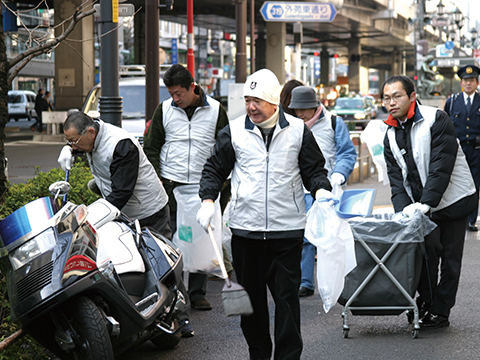
3. Roppongi Clean-Up
Roppongi Clean-Up is an activity continuously held mainly by the Environmental Beautification Working Committee of the self-governing association on the third Saturday of every month.
About 100 people participate each time in this volunteer cleanup work, which started with the will to “clean the city of Roppongi,” and they engage in the event with enthusiasm and enjoy making the city of Roppongi clean.
Participants from various facilities at Roppongi Hills including the residential tenants as well as the staff of facilities and retail stores within Roppongi Hills, office workers, cleaning staff and students at Hollywood University of Beauty & Fashion proactively participate in the event, and this network is spreading to places outside Roppongi Hills such as neighboring high schools and the Rotary Club.
Public Art
“Roppongi Hills Public Art & Design Project” was launched to supply a key element in realizing the grand vision of Roppongi Hills as a cultural center in Tokyo.
For this large-scale project with the ambitious theme of creating a new and much-needed cultural center in the heart of the city, over twenty world-class artists and designers were specially commissioned to create works to be placed at sites around the community.
Transcending the boundary between art and design, the exquisite yet functional works are shaping the creative landscape of this cultural center.
Undeveloped Sites Commitment
MHR and MIM aim to contribute to the creation and development of urban cities by providing investors with the opportunity to invest in high-quality urban assets.
With regard to investment in undeveloped sites, we will invest only in properties that have received green building certification under the recognition that development activities will have an impact on the natural environment and ecosystem.
